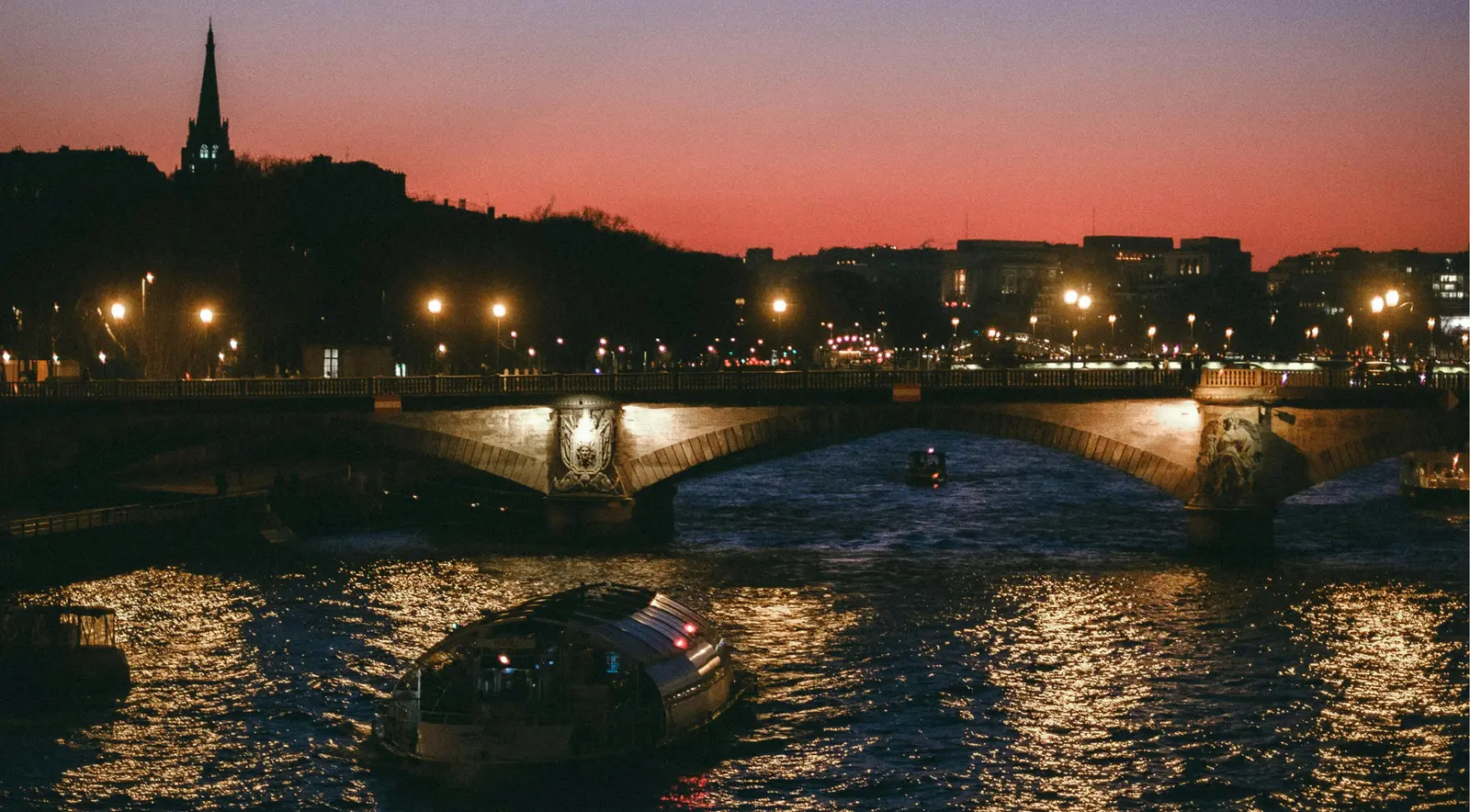
- Every evening Seine cruises sail all year
- About 1 hour A standard sightseeing cruise
- Midnight Last Eiffel Tower sparkle (1 a.m. in summer)
- Sept–Oct Best overall months
The short answer
Seine sightseeing cruises are available every evening of the year, with fewer departures in winter. The time of day you sail matters more than the month: the Eiffel Tower lights up at nightfall and sparkles on the hour, and sunset is around 5 p.m. in December and close to 10 p.m. in June.
If your dates are flexible, September and October offer the best overall balance for a night cruise. In mid-September sunset in Paris is around 8 p.m. and in mid-October around 7 p.m., so a boat an hour later sails in the dark without a late night. Average lows in Paris of 13°C and 10°C suit the open deck with a jacket. Both are busy months. January and February bring fewer visitors staying in the Paris region, and the boats keep running, but average lows are around 3°C.
Once your dates are fixed, book the boat for the light you want. A one-hour cruise leaving at sunset or up to half an hour after it takes you from the last daylight into the lights; one leaving an hour or more after sunset shows the city fully lit. In June and July even the last boats of the evening leave close to sunset and come back in the dark. From November to January, any boat from about 6:30 p.m. sails in the dark. Arrive 20 to 30 minutes early, as queues build at busy times. After days of heavy rain, check the river level on Vigicrues, the French flood-warning service, because high water has stopped the boats before.
- Sunset into the city lights
- Evening, just after sunset
- The city fully lit
- Evening, from an hour after sunset
- The Eiffel Tower sparkle
- Each night, on the hour
- A night cruise in June or July
- The last departures of the evening
- A night cruise from November to January
- From about 6:30 p.m.
- Best overall months for a night cruise
- September and October
- Warmest evenings on deck
- June to August, but dark late
- Fewer visitors staying in the Paris region
- January and February, but cold
- Check on the day
- Wind, rain and the river level
- Mid-December sunset · 4:54 p.m. at the Eiffel Tower
- Mid-June sunset · 9:56 p.m. at the Eiffel Tower
- Mid-October average low · 10°C (50°F) in Paris
- Eiffel Tower sparkle · 5 minutes on the hour after dark
Which departure to book
Most sightseeing cruises on the Seine last about an hour and loop from their pier past the Musée d'Orsay, the Louvre and Notre-Dame and back again, so the time you board decides what you see. There are three good choices, and each one moves with the season.
For sunset and the lights coming on, leave at sunset or up to half an hour after it. You see the façades in the last of the light on the way out and watch the bridges and monuments light up on the way back: nightfall in Paris comes 30 to 45 minutes after sunset, and the Eiffel Tower's lights about ten minutes after that. A boat that leaves well before sunset can be back at the pier before the tower lights up. Sunset is around 5 p.m. in December, around 7 p.m. in mid-March and mid-October, around 8 p.m. in mid-September and close to 10 p.m. in late June, so the boat that catches the sunset in October is a daylight cruise in June. In June and July even the last boats of the evening leave close to sunset, so a summer night cruise starts at dusk and comes back in the dark.
For the city fully lit, leave an hour or more after sunset. The Eiffel Tower's golden lighting switches on automatically within about ten minutes of nightfall. From November to January any boat from about 6:30 p.m. sails in the dark; in mid-September it is from about 9 p.m. and in mid-October from about 8 p.m.
For the Eiffel Tower sparkle, be on the water at the top of the hour. The tower sparkles for five minutes at the start of every hour once its lights are on, until midnight for most of the year and until 1 a.m. in summer, when it stays open late. A one-hour boat that leaves an Eiffel Tower pier on the hour after dark sets off under the sparkle and is back for the next one. The last sparkle is not the limit for a sightseeing cruise; the last boats are, and they leave between about 9 and 10:30 p.m., depending on the operator and the season.
Leave a margin at the pier. Arrive 20 to 30 minutes before your boat: the Bateaux Parisiens listing warns of queues in peak season, and a sunset departure is the one you cannot swap for the next boat without losing what you came for. If you would like to choose the evening on the day, look at the ticket type. The ticket for the Bateaux-Mouches Evening Lights Cruise, for example, needs no departure time and lets you board the next evening boat; other tickets are booked for a set date and time.
Fill the Rest of Your Paris Evening
A night cruise takes about an hour of your evening. Around it, Paris has the Eiffel Tower summit before an Eiffel Tower departure, the Louvre and the Musée d'Orsay on a late-opening night, Sainte-Chapelle and Notre-Dame on the Île de la Cité before a Pont Neuf boat, or Montmartre and a dinner in Saint-Germain afterwards. These are the Paris experiences travellers are booking right now.
Check your own date
Put in your date to see the sunset time and when to board for it, the first Eiffel Tower sparkle after dark, the latest regular sightseeing boats, and the temperature, rain and wind for the evening. Within about 16 days the card shows a forecast; further ahead it shows long-run averages for Paris and says so.
Pick a date to see sunset, the first sparkle after dark, the last boats and the evening weather.
Month by month
Temperatures, rain and gusty days are long-run averages for Paris. Sunset is for the 15th of each month at the Eiffel Tower. The last column is Eurostat's count of nights booked in tourist accommodation across the Paris region in 2025, shown as a share of the busiest month: it measures visitors staying in and around Paris, not people on the boats.
| Month | Sunset (15th) | Average high | Average low | Rainy days | Days with strong gusts | Nights booked in the Paris region (share of peak) |
|---|---|---|---|---|---|---|
| January | 5:22 p.m. | 8°C (46°F) | 3°C (38°F) | 10 | 6 | 71% |
| February | 6:11 p.m. | 9°C (48°F) | 3°C (38°F) | 9 | 5 | 67% |
| March | 6:55 p.m. | 13°C (55°F) | 6°C (42°F) | 10 | 5 | 80% |
| April | 8:42 p.m. | 17°C (62°F) | 8°C (46°F) | 9 | 3 | 94% |
| May | 9:25 p.m. | 20°C (68°F) | 11°C (52°F) | 9 | 3 | 95% |
| June | 9:56 p.m. | 23°C (74°F) | 14°C (58°F) | 8 | 2 | 97% |
| July | 9:50 p.m. | 26°C (78°F) | 16°C (61°F) | 7 | 1 | 100% |
| August | 9:07 p.m. | 26°C (78°F) | 16°C (61°F) | 8 | 2 | 94% |
| September | 8:05 p.m. | 22°C (71°F) | 13°C (55°F) | 8 | 2 | 89% |
| October | 7:02 p.m. | 17°C (62°F) | 10°C (50°F) | 10 | 3 | 95% |
| November | 5:11 p.m. | 11°C (52°F) | 6°C (43°F) | 10 | 4 | 80% |
| December | 4:54 p.m. | 8°C (46°F) | 4°C (39°F) | 11 | 5 | 88% |
A rainy day is one with at least 1 mm of rain, and a day with strong gusts is one where the wind gusts to 58 km/h (36 mph) or more at some point. The average low is the coldest point of the night, usually near dawn, so a 9 p.m. boat is normally a little warmer than that, although the breeze on the open deck can make it feel colder. An average is not a promise: there are mild evenings in February and cool ones in July.
The river through the year
September and October. Sunset falls from about 8 p.m. to 7 p.m. through these two months, then to around 5:45 p.m. after the clocks go back on the last Sunday of October, so a boat after dinner time sails in the dark. Average lows of 13°C and 10°C (55°F and 50°F) are comfortable on the open deck with a jacket, and strong gusts are rare, on about two or three days a month. They are busy months: nights booked in the Paris region were close to the summer peak in October 2025, and not far below it in September.
November to February. The pull of winter is the early dark. A 6 p.m. boat in December shows the whole city lit and still leaves the evening free for dinner, which also suits families with young children. The cost is the cold, with average lows of 3 to 6°C (38 to 43°F), and more wind: strong gusts come on five or six days a month in the depths of winter, against one or two in summer. The large boats have indoor seating, so the cold changes where you sit more than whether to go. January and February are the lightest months for visitors staying in the Paris region; December is busier, with Christmas and New Year.
March to May. Sunset moves from about 6:30 p.m. to past 9 p.m., with a jump of an hour when the clocks go forward on the last Sunday of March. In mid-March a boat at about 8 p.m. is already in the dark; by mid-May a night cruise means a boat at around 10 p.m. Average lows rise from 6°C to 11°C (42°F to 52°F), and April and May are busy months in Paris, with nights booked in the region above nine-tenths of the summer peak in 2025.
June to August. These are the warm evenings, with average lows of 14 to 16°C (58 to 61°F), so the open deck is pleasant even late at night. The catch is the clock: sunset is close to 10 p.m. in June and July, so a 7 p.m. "evening" cruise is a daylight cruise, and only the last boats of the evening reach the dark. By mid-August sunset is around 9 p.m. In 2023 and 2025 July was the busiest month for nights booked in the Paris region; in 2024, the year of the Olympic Games, the peak moved to October.
How busy Paris gets
There are no monthly passenger figures for the Seine boats. The nearest monthly figure is Eurostat's count of nights booked in hotels and other tourist accommodation across the Paris region. In each of 2023, 2024 and 2025, January and February were the two lightest months, at about two-thirds to three-quarters of the busiest month, and summer, April, May and October were all close to the top. The curve is fairly flat for a big tourist city, so expect busy evening boats for much of the year.
The series counts everyone staying in the region, including business travellers and visitors who never go near the river, so treat it as a guide to how busy Paris is, not to how full your boat will be. What you will notice on the night is the queue at the pier at busy times, which is one more reason to arrive early.
Rain, wind and high water on the day
A wet evening still works on a sightseeing cruise. The large boats run by Bateaux Parisiens and Bateaux-Mouches have indoor seating as well as open decks, so on a wet evening you watch through the windows; window glare at night makes photographs harder, but the lit monuments are still there. Wind matters more if you want the open deck. On a gusty evening the upper deck is cold and some of it may be closed, so check the gust forecast in the date checker and bring a warm layer whatever the month.
High water can stop the boats altogether. After days of heavy rain the Seine can rise until passenger boats can no longer pass safely under the bridges, and cruises have been halted for days at a time: in June 2016 Vedettes de Paris stopped for about ten days, and in January 2018 the river peaked at 5.84 m in Paris and the sightseeing boats stayed moored. If it has rained hard in the days before your cruise, check the river level on Vigicrues, the French flood-warning service, and your operator's notices, since operators sail subject to navigation conditions and can change the route. Our guide to cruising in the rain covers what happens to your ticket.
Which cruise to book for the timing
For a night or sunset cruise, the timetable and the ticket matter more than the brand, because all of these boats follow much the same loop through the centre of Paris. These three cover the main ways of fitting a cruise to your evening.
Bateaux Parisiens from the Eiffel Tower
For choosing your exact time. Boats leave the pier below the Eiffel Tower about every 30 minutes from April to September and roughly hourly from October to March, with audio commentary, so you can pick the departure closest to sunset or the first one after dark. Rated 4.4 from 92,492 reviews.
Bateaux-Mouches Evening Lights Cruise
For choosing the evening on the day. The ticket has no set departure time: you board the next evening boat at Pont de l'Alma, and it stays valid for six months, although it cannot be refunded. Useful if you want to wait for a dry, still evening. Rated 4.4 from 7,087 reviews.
Vedettes du Pont Neuf from the Île de la Cité
For a live guide and a smaller boat. It leaves from the tip of the Île de la Cité, close to the Louvre and Notre-Dame, with commentary in English and French, which suits an evening that starts in the historic centre. Rated 4.6 from 517 reviews.
Champagne and dinner cruises follow the same clock. A dinner cruise that boards at 6 p.m. in June is a daylight dinner, while the same boat in November eats under the lights. Our champagne cruise guide and dinner cruise comparison cover what each ticket includes, and our Seine cruise timetable guide lists each operator's hours.
Frequently Asked Questions About Timing Your Cruise
What is the best time for a Seine night cruise?
Book a one-hour cruise that leaves at sunset or up to half an hour after it if you want the evening light turning into the city lights, or an hour or more after sunset if you want the city fully lit. Sunset is around 5 p.m. in December and close to 10 p.m. in June, so check it for your date. If your dates are flexible, September and October give you a dark river at a reasonable hour and evenings mild enough for the open deck.
What time should I take a sunset cruise in Paris?
Leave at sunset or up to half an hour after it, so from about 5 p.m. in mid-December, 7 p.m. in mid-October, 8 p.m. in mid-September and 10 p.m. in mid-June. A one-hour cruise then sees the last of the light on the way out and is still on the water when the lights come on, 40 to 55 minutes after sunset. Arrive at the pier 20 to 30 minutes before the boat, and use the date checker on this page for the exact sunset on your day.
Can you see the Eiffel Tower sparkle from a Seine cruise?
Yes. The tower sparkles for five minutes at the start of every hour from nightfall until midnight, or until 1 a.m. in summer when it stays open late. A one-hour boat that leaves an Eiffel Tower pier on the hour after dark sets off under the sparkle and is back for the next one.
Is a Seine night cruise good in winter?
Yes, if you dress for it. Sunset is just before 5 p.m. in December, so a 6 p.m. boat shows the whole city lit and leaves the evening free for dinner. Average lows in Paris are around 3 to 4°C (37 to 39°F) from December to February, so expect to watch much of the cruise from the indoor cabin. After heavy rain, check the river level, because high water has stopped the boats before.
Which month is quietest for a Paris night cruise?
There are no monthly passenger figures for the boats. In Eurostat's figures for nights booked in tourist accommodation across the Paris region, January and February were the two lightest months in each of 2023, 2024 and 2025, at about two-thirds to three-quarters of the busiest month. That counts visitors staying in the region, not people on the boats, and the cruises keep running all winter.
Do Seine cruises run in the rain?
Yes. The large sightseeing boats have indoor seating as well as open decks, so on a wet evening you watch through the windows. What can stop the boats is high water after days of heavy rain, when the Seine rises too far for boats to pass safely under the bridges. If it has rained hard in the days before your cruise, check Vigicrues and your operator's notices.
Sources and methodology
How the figures on this page were sourced
Temperatures, rain and gusty days are Météo-France's 1991–2020 averages for its Paris-Montsouris station in the 14th arrondissement, about 4 km south of the river, taken from the station's published climate sheet rather than from a model grid.
Sunset times are calculated for the Eiffel Tower pier at 48.858°N, 2.295°E with the standard NOAA method, in Paris local time with summer time applied, and agree with published tables to within a few minutes. The table uses the 15th of each month, a date never close to a clock change; the date checker calculates your own day.
The Eiffel Tower's lights and sparkle come from the monument's own illuminations page on toureiffel.paris, in English and French: golden lighting within about ten minutes of nightfall, a five-minute sparkle at the start of each hour until the tower closes, with the last sparkle at midnight, or 1 a.m. in summer when the tower closes at 12:45 a.m.
Departure frequencies and ticket rules come from the operators' own pages and from the GetYourGuide listings linked on this page, read on 24 October 2026. Ratings and review counts are GetYourGuide's, read the same day.
Nights booked in the Paris region are Eurostat's monthly series of nights spent in tourist accommodation for the Île-de-France region (table tour_occ_nin2m) for 2023, 2024 and 2025.
High water: the June 2016 stoppage is from Vedettes de Paris as reported by the French press at the time, and the January 2018 peak of 5.84 m is Vigicrues' reading at Paris as reported by the press.
Forecasts in the date checker come from Open-Meteo within its roughly 16-day window; beyond it the card shows the Paris-Montsouris averages and says so.
Where the evidence stops
- There are no monthly passenger figures for the Seine boats. The Paris-region accommodation series is a proxy for how busy the city is; it does not measure how full a boat will be.
- Beyond about 16 days the date checker shows long-run averages, not a forecast, and it says so on the card.
- Operators publish their timetables mainly through their booking pages, and the versions differ. Bateaux Parisiens gives roughly hourly boats from October to March with a last departure about 10 p.m. (10:30 p.m. at weekends and in school holidays), while some reseller listings still show an earlier last boat. This page gives a range for the last boats, and the date checker does not guess a timetable.
- No river level is published at which every cruise stops; each operator decides for its own boats, which differ in height. The page therefore names no threshold and points you to Vigicrues and the operator.
- The last sparkle follows the Eiffel Tower's own website: its illuminations page and its article on when the tower lights up both give midnight, or 1 a.m. during the summer late opening (checked November 2026). Some older guides still give 11 p.m., the time set by the 2022 energy-saving plan. The dates of the summer late opening are published by the tower and change from year to year.
- The climate figures are for a park station about 4 km from the river. On the water, the breeze usually makes it feel cooler than the figure suggests.
Related Paris cruise guides
- Seine river cruise at night: what you see after dark and which evening boats to choose.
- Cruise times, hours and duration: first and last departures for each operator.
- Eiffel Tower Seine cruise: boats from the tower, and tower-and-cruise combinations.
- Departure points: which pier suits the rest of your day.
- What to wear: layers for an evening on the river.